
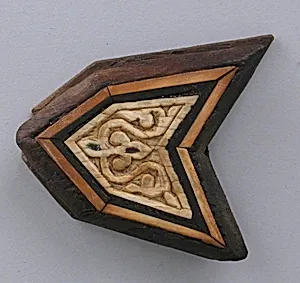
Panel
Unknown Artist
14th–15th century
Medium
Wood; inlaid with plain and carved ivory
Dimensions
Ht. 2 13/16 in. (7.2 cm) W. 2 1/4 in. (5.7 cm) D. 5/8 in. (1.6 cm)
Classification
Wood
Department
Islamic Art
Museum
Metropolitan Museum of Art, New York, NY
Credit
Rogers Fund, 1907
Accession Number
07.236.102
Rights
Public Domain
Art Historical Context
This exquisite wooden panel, dating to the 14th–15th century, exemplifies refined craftsmanship of Islamic art. Measuring just 2⅞ × 2¼ inches, it is a delicate example of wood inlaid with both plain and intricately carved ivory—a technique that demanded exceptional precision. Artisans would carefully cut recesses into the wood and fit the ivory pieces flush, creating luminous contrasts that catch the light and highlight geometric or arabesque patterns typical of the era. In the Islamic world during this period, such panels often adorned luxury objects like caskets, furniture, or mirror cases, symbolizing wealth and piety. The use of ivory, prized for its creamy sheen and workability, elevated everyday woodwork into high art, blending functionality with spiritual symbolism. Though the artist remains unknown, this piece reflects the anonymous mastery of workshops in regions like Egypt or Syria, where Mamluk-era artisans thrived. Today, housed in the Metropolitan Museum of Art's Islamic Art department (acquired via the Rogers Fund in 1907), it invites us to marvel at medieval ingenuity—tiny in scale, yet grand in its testament to cultural splendor.