
Panel
Unknown Artist
13th–14th century
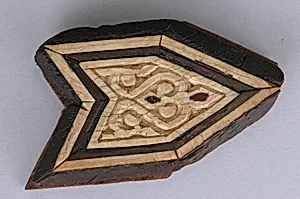
Medium
Wood; inlaid with plain and carved ivory
Dimensions
Ht. 1 7/16 in. (3.7 cm) W. 2 1/2 in. (6.3 cm) D. 3/8 in. (1 cm)
Classification
Wood
Department
Islamic Art
Museum
Metropolitan Museum of Art, New York, NY
Credit
Rogers Fund, 1907
Accession Number
07.236.107
Rights
Public Domain
Art Historical Context
This delicate wooden panel, crafted by an unknown artist in the 13th–14th century, exemplifies exquisite artistry of Islamic decorative traditions. Measuring just 1 7/16 inches high and 2 1/2 inches wide, its diminutive size suggests it was likely part of a larger furniture piece, such as a box, casket, or architectural element, where such panels added subtle luxury to everyday objects. The medium—wood inlaid with both plain and intricately carved ivory—highlights advanced techniques from the medieval Islamic world, possibly regions like Egypt, Syria, or Iraq under Mamluk influence. Ivory inlay, a hallmark of high-status craftsmanship, created contrasting textures and luminous effects, symbolizing refinement and piety. These motifs often drew from nature or geometry, reflecting Islamic aniconism and mathematical precision in design. Acquired through the Rogers Fund in 1907 and housed in the Metropolitan Museum of Art's Islamic Art Department, this panel offers a window into the sophisticated material culture of the era, where even small objects embodied cultural prestige and technical mastery. Visitors can appreciate how such works bridged utility and beauty in pre-modern Islamic societies.