
Panel
Unknown Artist
14th–15th century
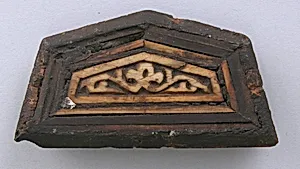
Medium
Wood; inlaid with plain and carved ivory
Dimensions
Ht. 2 13/16 in. (7.1 cm) W. 1 5/8 in. (4.2 cm) D. 9/16 in. (1.5 cm)
Classification
Wood
Department
Islamic Art
Museum
Metropolitan Museum of Art, New York, NY
Credit
Rogers Fund, 1907
Accession Number
07.236.109
Rights
Public Domain
Art Historical Context
This exquisite wooden panel, crafted by an unknown artist in the 14–15th century, the refined artistry of Islamic decorative traditions. Measuring just 2 13/16 inches and 1 5/8 inches wide, its diminutive scale suggests it once adorned a small luxury object such as a box, casket, or furniture inlay. The medium—wood inlaid with both plain and intricately carved ivory—highlights a sophisticated technique prized in the Islamic world, where contrasting materials created luminous, tactile effects that elevated everyday items to treasures. Inlaid ivory work flourished during this period, blending woodworking precision with ivory carving's delicate finesse. The plain ivory provided smooth, glowing surfaces, while carved elements likely featured geometric or arabesque patterns symbolic of Islamic aesthetics—endless interlocking designs evoking infinity and divine order. Such panels reflect the cultural importance of craftsmanship in medieval Islamic societies, where objects were not just functional but profound expressions of faith, beauty, and status. Acquired through the Rogers Fund in 1907 and now housed in the Metropolitan Museum of Art's Islamic Art Department, this panel invites visitors to appreciate the anonymous mastery behind enduring luxury. Its survival speaks to the portability and value of these artifacts, bridging us to a vibrant era of cross-cultural exchange.