
Panel
Unknown Artist
13th–14th century
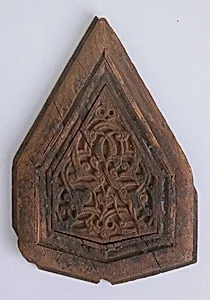
Medium
Wood; carved, inlaid with ivory or bone
Dimensions
Ht. 7 in. (17.8 cm) W. 4 15/16 in. (12.5 cm) D. 1/2 in. (1.3 cm)
Classification
Wood
Department
Islamic Art
Museum
Metropolitan Museum of Art, New York, NY
Credit
Rogers Fund, 1907
Accession Number
07.236.22
Rights
Public Domain
Art Historical Context
This exquisite carved wood panel, dating to the 13th–14th century, hails from the Islamic world and exemplifies the masterful craftsmanship of medieval artisans. Measuring just 7 inches high and nearly 5 inches wide, its delicate scale suggests it once adorned a small piece of furniture, such as a casket, box, or architectural element like a door or mihrab surround. Crafted from wood and inlaid with ivory or bone the panel showcases a sophisticated technique known as marquetry, where contrasting materials are precisely cut and embedded to create intricate patterns—likely geometric motifs or arabesques, hallmarks of Islamic decorative arts that emphasize harmony and infinity without figurative representation. In the Islamic tradition of this era, such panels were prized for their technical virtuosity and spiritual resonance, often produced in workshops across Syria, Egypt, or Persia during the Mamluk or Mongol-influenced periods. The use of ivory or bone inlays added luminosity and luxury, reflecting the era's trade in exotic materials and patronage by courts and mosques. Acquired through the Rogers Fund in 1907, this artifact at the Metropolitan Museum of Art offers a window into a golden age of Islamic design, where everyday objects became portals to divine beauty. Visitors, pause to admire how the shallow depth of just half an inch belies the depth of skill involved—each inlay a testament to patience and precision.