
Panel
Unknown Artist
dated 1296
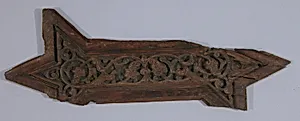
Medium
Wood; carved and inlaid
Dimensions
H. 4 5/8 in. (11.8 cm) W. 14 3/8 in. (36.5 cm) D. 1/2 in. (1.2 cm)
Classification
Wood
Department
Islamic Art
Museum
Metropolitan Museum of Art, New York, NY
Credit
The Friends of the Department of Islamic Art Fund, 1971
Accession Number
1971.97.3
Rights
Public Domain
Art Historical Context
This exquisite wooden panel, dated precisely to 1296, exemplifies the masterful craftsmanship of medieval Islamic art. Carved and inlaid with materials—likely ivory, bone, or mother-pearl—the slim rectangle (just 4 5/8 inches high 14 3/8 inches wide) reveals the sophistication of woodworkers from the late 13th century, a period marked by the rise of theamluk dynasty in Egypt and Syria. Such panels often adorned doors, furniture, or architectural elements in mosques and palaces, blending utility with opulent decoration. The technique of carving and inlay, known as *tarkib* or *tarsia* in Islamic traditions, allowed artisans to create intricate geometric patterns, arabesques, and possibly epigraphic inscriptions that evoke spiritual harmony and infinite complexity—hallmarks of Islamic design avoiding figurative representation. The panel's shallow depth (1/2 inch) underscores its delicacy, designed for surface embellishment rather than freestanding sculpture. Acquired in 1971 through The Friends of the Department of Islamic Art Fund at The Metropolitan Museum of Art, this anonymous masterpiece invites visitors to marvel at the enduring legacy of Islamic artisans, whose innovations in woodwork influenced global decorative arts for centuries.