
Panel
Unknown Artist
dated 1296
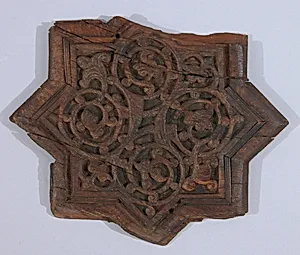
Medium
Wood; carved and inlaid
Dimensions
H. 8 11/16 in. (22 cm) W. 5/8 in. (1.6 cm)
Classification
Wood
Department
Islamic Art
Museum
Metropolitan Museum of Art, New York, NY
Credit
Gift of E. Safani, 1971
Accession Number
1971.228.1
Rights
Public Domain
Art Historical Context
This exquisite wooden panel, dated 1296, hails from the rich tradition of Islamic art and exemplifies the masterful craftsmanship of the late medieval Islamic world. Measuring just 8 11/16 inches high and a slender 5/8 inch thick, its compact form suggests it once adorned furniture, doors, or architectural elements in a palace, mosque, or scholarly setting. Carved with intricate motifs and inlaid with contrasting materials—likely ivory, bone, or precious woods—the panel showcases the Islamic artisans' skill in creating luminous, geometric patterns that evoke spiritual harmony and infinite beauty. The technique of carving and inlay, known as *tarz-i naqashi* in Persian traditions or similar methods across Mamluk Egypt and Syria, was a pinnacle of 13th-14th century woodwork. Artisans meticulously hollowed designs into the wood, embedding inlays for a jewel-like effect that catches the light, symbolizing divine order in aniconic Islamic decoration. Dated precisely to 1296, it captures a golden age of cultural exchange under Mongol-influenced Ilkhanid or Mamluk patronage, where such panels decorated elite spaces. Today, gifted to the Metropolitan Museum of Art in 1971, this anonymous masterpiece invites us to marvel at the enduring elegance of Islamic decorative arts—timeless in their precision and poetic in their restraint.