
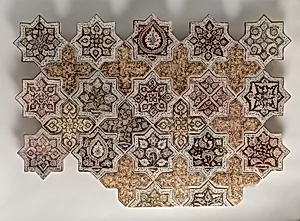
Panel Composed with Tiles in Shape of Eight-pointed Stars and Crosses
Unknown Artist
1260–70
Medium
Stonepaste; luster-painted on opaque white glaze under transparent glaze
Dimensions
Individual tile: H. 8 in (20.3 cm) W. 8 in. (20.3 cm) Mounted panel - 32 elements: H. 28 in. (71.1 cm) W. 40 in. (101.6 cm) D. 1 1/2 in. (3.8 cm) Wt. 51 lb (23.1 kg)
Classification
Ceramics-Tiles
Department
Islamic Art
Museum
Metropolitan Museum of Art, New York, NY
Credit
H.O. Havemeyer Collection, Gift of Horace Havemeyer, 1941
Accession Number
41.165.22
Rights
Public Domain
Art Historical Context
This stunning panel, composed of 32 stonepaste tiles shaped as eight-pointed stars and, dates to 1260–70 and hails from the Islamic world, likely Syria or Egypt during the Mamluk era. Assembled into a 28-by-40-inch wall decoration, it exemplifies the opulent tilework that adorned mosques, madrasas, and palaces transforming sacred and secular spaces with geometric splendor. The eight-pointed star, a hallmark of Islamic design, evokes infinity and divine order, while crosses here serve as geometric motifs rather than Christian symbols, reflecting the faith's aniconic traditions. Crafted from stonepaste—a fine frit body mimicking porcelain's translucency—the tiles feature luster-painting: metallic oxides applied over an opaque white glaze, then fired twice under special conditions to produce a shimmering, golden iridescence beneath a transparent top glaze. This technically demanding technique, perfected in the 13th century after earlier Iraqi innovations, was a luxury art form, rivaling Chinese porcelain in prestige and traded across the Mediterranean. A gift to the Metropolitan Museum from the H.O. Havemeyer Collection in 1941, this panel invites visitors to marvel at medieval ingenuity—where math meets mysticism in enduring beauty.