
Panel (Furnishing Fabric)
20th century
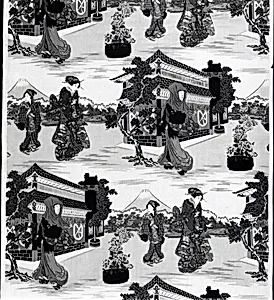
Medium
Cotton, plain weave; block printed; glazed
Dimensions
218.8 × 132.5 cm (86 1/2 × 52 in.)
Classification
textile
Department
Textiles
Museum
Art Institute of Chicago
Accession Number
105196
Rights
Public Domain
Art Historical Context
This striking furnishing fabric panel, created by the renowned Japanese artist Utagawa Kunis I (also known as Toyokuni) in the 20th, exemplifies the enduring legacy of ukiyo-e aesthetics in textile design. Measuring an impressive 218.8 × 132.5 cm, it was crafted from cotton plain weave, meticulously block-printed and glazed for a vibrant, durable finish. Housed in the Art Institute of Chicago's Textiles Department, this large-scale piece likely served as a decorative screen or room divider in traditional Japanese interiors, blending artistry with functionality. Kunisada, a master of the Utagawa school, was celebrated for his colorful woodblock prints depicting kabuki actors, beauties, and daily life during Japan's Edo period. Though this 20th-century work postdates his lifetime, it reflects his signature bold compositions and intricate patterns, adapted to block-printing techniques. This method—carving designs into wooden blocks, inking them, and pressing onto fabric—allowed for efficient production of repeatable motifs, a hallmark of Japanese textile innovation from the 17th century onward. The panel's glazed surface enhances color saturation and sheen, protecting the dyes while evoking the opulence of merchant-class homes. It invites visitors to appreciate how ukiyo-e's "pictures of the floating world" transcended paper, infusing everyday furnishings with cultural vibrancy and storytelling. A testament to artistic continuity, it bridges centuries of Japanese craftsmanship.
About the Artist
Utagawa Kunisada I (Toyokuni III) · 1786–1864
Utagawa Kunisada I, also known as Toyokuni III (1786–1865), was born Sumida Shōgorō in the Honjo district of Edo (modern Tokyo) into a family that operated a hereditary ferry-boat service, providing stability after his father's early death. Displaying prodigious talent in drawing from childhood, he became an apprentice to the master Utagawa Toyokuni I around 1801 at age fifteen, entering the prest...