
Panel of velvet
Unknown Artist
mid-15th century
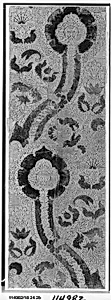
Medium
Silk and metal-wrapped thread; pile-on-pile cut, voided, brocaded velvet with metal-wrapped thread loops
Dimensions
L. 65 1/2 x W. 22 1/2 inches (166.4 x 57.2 cm)
Classification
Textiles-Velvets
Culture
Italian or Spanish
Department
European Sculpture and Decorative Arts
Museum
Metropolitan Museum of Art, New York, NY
Credit
Rogers Fund, 1918
Accession Number
18.24.2b
Rights
Public Domain
Tags
Art Historical Context
This stunning *Panel of Velvet* from mid-15th century exemplifies the opulent textile arts of Renaissance-era Italy or Spain. Measuring an impressive 65½ by 22½ inches, it was likely created for ecclesiastical vestments, luxurious furnishings, or high-status garments, reflecting the era's fascination with sumptuous materials that symbolized wealth and piety. Produced during a time when velvet weaving reached new heights in European workshops, particularly in Lucca, Italy, and Catalonia, Spain, this piece highlights the cross-cultural exchanges along Mediterranean trade routes. Crafted from silk and metal-wrapped threads, the panel employs sophisticated techniques: pile-on-pile cut velvet for layered depth, voided weaving to create open patterns, and brocading with metallic loops that catch the light dramatically. Floral and leafy motifs—evident in its intricate designs—evoke the natural world, a common Renaissance theme blending Gothic ornamentation with emerging realism. These methods demanded skilled labor and expensive looms, making such velvets rare treasures coveted by nobility and clergy. Today, housed in the Metropolitan Museum of Art's European Sculpture and Decorative Arts Department (acquired via the Rogers Fund in 1918), this anonymous masterpiece invites us to appreciate the tactile artistry of medieval craftspeople, whose innovations in texture and shine continue to inspire modern design.