
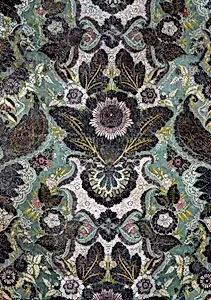
Panel (Showing "Lace" Design)
c. 1726
Medium
Silk, silvered-metal-strip-wrapped silk, warp-float faced 7:1 satin weave with supplementary brocading wefts and supplementary binding warps tying some self-patterning ground wefts in plain interlacing
Dimensions
95.7 × 105.1 cm (37 5/8 × 41 3/8 in.); Warp repeat: H.: 41.2 cm (16 1/4 in.)
Classification
textile
Department
Textiles
Museum
Art Institute of Chicago
Accession Number
29786
Rights
Public Domain
Art Historical Context
This exquisite silk panel, dating to around 1726, showcases a delicate "Lace" design that masterfully imitates the intricate openness of handmade lace through woven patterns. Created by an unknown artisan, it measures nearly a meter square, suggesting its use as a luxurious garment panel, curtain, or upholstery element in elite European households during the early Rococo era. Housed in the Art Institute of Chicago's Textiles Department, it exemplifies the height of 18th-century textile artistry, when silk weaving became a symbol of wealth and sophistication. The medium is a technical marvel: a warp-float faced 7:1 satin weave provides a luminous sheen, enhanced by supplementary brocading wefts for the lace-like motifs and silvered-metal-strip-wrapped silk threads that catch the light like jewelry. Supplementary binding warps secure self-patterning ground wefts in plain interlacing, creating depth and texture without embroidery. This complex loom technique, with a 41.2 cm warp repeat, highlights the skill of specialized weavers—likely from weaving centers like Lyon or Spitalfields—pushing the boundaries of mechanized pattern-making before the Industrial Revolution. Such panels were cultural treasures, adorning nobility and reflecting the era's fascination with light, illusion, and extravagance. Today, they remind us how textiles wove artistry into everyday luxury.
About the Artist
Unknown
The artist designated as "Unknown" in our virtual museum's collection exemplifies a poignant chapter in art history: creators whose identities have faded into obscurity despite the enduring power of their work. With only one known artwork attributed to them in our holdings, this figure represents countless anonymous hands that shaped visual culture across centuries. Museums worldwide, including th...