
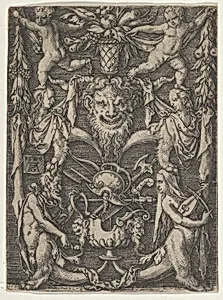
Panel with Grotesque Candelabrum Containing Satyrs, Children and a Trophy
Medium
Engraving
Dimensions
Sheet: 2 11/16 × 1 15/16 in. (6.9 × 5 cm)
Classification
Prints|Ornament & Architecture
Department
Drawings and Prints
Museum
Metropolitan Museum of Art, New York, NY
Credit
Rogers Fund, 1918
Accession Number
17.74.1
Rights
Public Domain
Tags
Art Historical Context
Heinrich Aldegrever, a prominent German engraver of the Renaissance known as one of the "Little Masters" for his exquisite small-scale works, created this *Panel with Grotesque Candelabrum Containing Satyrs, Children and Trophy* in 1550. Measuring just 2 11/16 × 1 15/16 inches, this delicate engraving exemplifies the Northern Renaissance fascination with intricate ornamentation. Aldegrever, active in Soest, blended goldsmith precision with printmaking to produce designs that served as models for artisans crafting jewelry, metalwork, and architecture. The composition bursts with grotesque fantasy: a towering candelabrum frames playful satyrs—mythical half-goat revelers—and frolicking children, intertwined with trophies and musical instruments. Grotesques, revived from ancient Roman frescoes discovered in the 15th century, symbolized whimsical abundance and were staples in Renaissance decorative arts. Aldegrever's fine engraving technique captures swirling motifs with remarkable clarity, allowing the tiny sheet to inspire larger-scale decorations. Held in the Metropolitan Museum of Art's Drawings and Prints department (Rogers Fund, 1918), this print highlights how such works bridged art and craft, influencing Mannerist ornament across Europe and delighting collectors with their lively, mythical charm.
About the Artist
Heinrich Aldegrever · 1502–1561
Heinrich Aldegrever, born in 1502 in Paderborn, Westphalia, to parents Herman and Katherine Trippenmeker—a family of clog-makers known by the dialect name Trippenmecker—emerged as a multifaceted artist in the German Renaissance. His early training remains undocumented, though he likely apprenticed in a Soest goldsmith's workshop after relocating there around 1525, where he joined the painters' gui...