
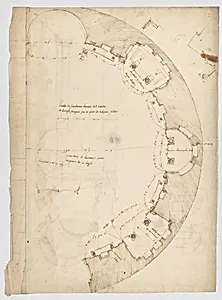
Pantheon, partial plan; details (recto) Pantheon, rectangular niche, perspective; vault, detail (verso)
early to mid-16th century
Medium
Dark brown ink, black chalk, and incised lines
Dimensions
sheet: 16 15/16 x 12 5/8 in. (43 x 32 cm)
Classification
Drawings|Ornament & Architecture
Department
Drawings and Prints
Museum
Metropolitan Museum of Art, New York, NY
Credit
Purchase, Rogers Fund, Joseph Pulitzer Bequest, and Mark J. Millard Gift, 1968
Accession Number
68.769.5
Rights
Public Domain
Tags
Art Historical Context
This exquisite 16th-century drawing created by an anonymous French artist the early to mid-0s, captures intricate details of Rome's ancient Pantheon—one of antiquity's greatest architectural marvels. On recto side, it features a partial plan and ornamental details, while the verso presents a perspective view of a rectangular niche and a close-up of the Pantheon’s iconic vault. Rendered in dark brown ink, black chalk and incised lines on a generous sheet measuring 16 15/16 x 12 5/8 inches, this work exemplifies the Renaissance fascination with classical Roman engineering and design. During the 16th century, French artists and architects traveled to Italy to study ancient monuments, fueling the revival of classical forms across Europe. This drawing reflects that scholarly zeal, with its precise incised lines—likely used for tracing or transferring designs—highlighting the Pantheon's harmonious proportions, coffered dome, and sculptural niches. Such technical drawings were vital tools for disseminating architectural knowledge, bridging ancient ingenuity with emerging Renaissance styles. Housed in the Metropolitan Museum of Art's Department of Drawings and Prints (acquired in 1968), this anonymous gem offers a window into how early modern minds decoded the Pantheon's enduring legacy of light, space, and structure, inspiring generations of builders.