
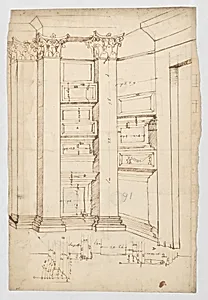
Pantheon, vestibule, perspective; panel moulding, profiles (recto) Pantheon, rectangular niche, plan; half round niche, plan (verso)
early to mid-16th century
Medium
Dark brown ink, black chalk, and incised lines
Dimensions
sheet: 16 15/16 x 12 5/8 in. (43 x 32 cm)
Classification
Drawings|Ornament & Architecture
Department
Drawings and Prints
Museum
Metropolitan Museum of Art, New York, NY
Credit
Purchase, Rogers Fund, Joseph Pulitzer Bequest, and Mark J. Millard Gift, 1968
Accession Number
68.769.6
Rights
Public Domain
Tags
Art Historical Context
This exquisite anonymous drawing from early to mid-16th France captures the Renaissance fascination with classical antiquity. On the recto, it presents a precise perspective view of the Pantheon vestibule in Rome, complete with detailed profiles of panel mouldings, showcasing the artist’s meticulous study of ancient Roman architecture. The verso features plans for a rectangular niche and a half-round niche, revealing practical design explorations likely intended for replication or adaptation in contemporary projects. Created using dark brown ink, black chalk, and incised lines on a generous sheet (16 15/16 x 12 5/8 in.), the work exemplifies the technical sophistication of French architectural draftsmen during the period. Incised lines—subtle pricks pierced through the paper—allowed for easy transfer of motifs to other surfaces, a clever technique underscoring its functional role in workshops. Housed in the Metropolitan Museum of Art’s Drawings and Prints department, this piece highlights the era’s revival of Roman forms, influencing French ornamental and architectural styles amid the spread of humanism and grand building campaigns. As a rare survivor of workshop sketches, it offers visitors a window into how 16th-century artists bridged ancient grandeur with emerging Renaissance innovation, blending observation with creative interpretation.