
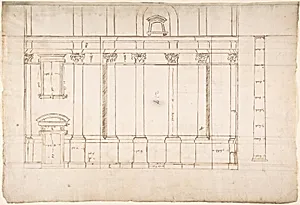
Santa Maria Maggiore, Sforza Chapel, elevation (recto) Unknown, entablature, partial cornice, and column or pilaster base profile (verso)
early to mid-16th century
Medium
Dark brown ink, black chalk, and incised lines
Dimensions
sheet: 11 13/16 x 17 5/16 in. (30 x 44 cm)
Classification
Drawings
Department
Drawings and Prints
Museum
Metropolitan Museum of Art, New York, NY
Credit
Gift of Janos Scholz and Anne Bigelow Scholz, in memory of Flying Officer Walter Bigelow Rosen, RCAF, 1949
Accession Number
49.92.23
Rights
Public Domain
Tags
Art Historical Context
This exquisite architectural drawing from the early to mid-16th captures the elevation of the Sforza Chapel in Rome's Basilica of Santa Maria Maggiore on its recto (front) side. Created by an anonymous French artist it meticulously renders the chapel's facade, highlighting Renaissance proportions and classical details. The verso features precise profiles of an entablature, partial cornice, and a column or pilaster base—essential elements for stone carvers or builders—demonstrating the sheet's practical use in design transfer. Executed in dark brown ink, black chalk, and incised lines, the work showcases techniques typical of 16th-century draftsmen. Incising allowed outlines to be traced onto other surfaces, bridging the gap between concept and construction. This French perspective on Italian architecture reflects the era's cross-cultural exchange, as Northern European artists traveled to study Rome's ancient and contemporary marvels during the High Renaissance. Housed in the Metropolitan Museum of Art's Drawings and Prints department, this gift from Janos and Anne Bigelow Scholz honors a family member's wartime service. It offers visitors a window into the meticulous world of Renaissance architecture, where every line contributed to enduring masterpieces like the Sforza Chapel.