
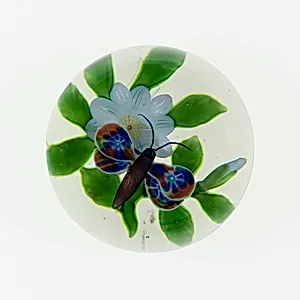
Paperweight
c. 1845–60
Medium
Glass
Dimensions
Diam.: 7.6 cm (3 in.)
Classification
paperweight
Department
Applied Arts of Europe
Museum
Art Institute of Chicago
Accession Number
187859
Rights
Public Domain
Art Historical Context
This exquisite glass paperweight from Baccarat Glassworks, to around 1845–60, exemplifies the pinnacle of19th-century French luxury. Measuring just 3 inches in diameter, this compact gem belongs to the Applied Arts of collection at the Art Institute of. Baccarat, founded in 1764 in Lorraine, France, rose to international fame during the mid-1800s for its unparalleled crystal production, blending industrial precision with artistic virtuosity. Paperweights like this one emerged in the 1840s as practical yet decorative desk accessories, protecting documents from drafts while showcasing the glassmaker's skill. Baccarat pioneered innovative techniques such as millefiori—creating intricate floral patterns from fused glass canes sliced thin and embedded in a clear dome—and sulfides, where milky-white figures were molded inside. These methods highlighted the era's fascination with optical effects and miniaturization, turning everyday objects into collectible art. Culturally, Baccarat paperweights symbolized opulence during France's Second Empire, gracing the desks of royalty and the bourgeoisie. Today, they remain coveted by collectors for their clarity, color vibrancy, and technical mastery, offering a window into an age when functionality met fine art.
About the Artist
Baccarat Glassworks
Baccarat Glassworks, founded in 1764 in the Lorraine village of Baccarat, France, emerged from a royal decree by King Louis XV granting Bishop Monseigneur de Montmorency-Laval permission to establish a glass factory. Leveraging abundant local driftwood from the Vosges forest and skilled craftsmen, the works initially produced soda glass for windows, mirrors, and everyday stemware, employing thousa...