
Paperweight
c. 1845/60
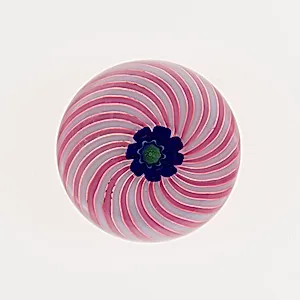
Medium
Glass
Dimensions
Diam.: 4.3 cm (1 3/4 in.)
Classification
paperweight
Department
Applied Arts of Europe
Museum
Art Institute of Chicago
Accession Number
188050
Rights
Public Domain
Art Historical Context
This elegant glass paperweight, crafted by the renowned Clichy Glasshouse in France around 1845–1860, exemplifies the golden age of decorative paperweights in Europe. Measuring just 4.3 centimeters in diameter, the compact object was designed as both a practical desk accessory and a miniature work of art. Clichy, one of three leading French factories alongside Baccarat and Saint-Louis, specialized in intricate glass creations that captivated collectors during the mid-nineteenth century. The medium of glass allowed artisans to embed colorful patterns and motifs within a clear dome, using techniques such as millefiori—literally “thousand flowers”—where thin rods of colored glass were sliced into cross-sections and arranged like tiny mosaics. These paperweights emerged during a period of industrial innovation and refined taste, when such objects became fashionable among the educated classes as symbols of refinement and scientific curiosity about optics and materials. Today, this piece in the Art Institute of Chicago’s collection of Applied Arts of Europe highlights how everyday functional items could embody extraordinary craftsmanship, preserving the delicate beauty of Victorian-era glassmaking for modern viewers.
About the Artist
Clichy Glasshouse · 1837–1885
The Verrerie de Clichy, also known as the Clichy Glasshouse or Cristalleries de Clichy, was established in 1837 through the merger of local glassworks at Billancourt near Paris, under the direction of Rouyer and Maes. The firm relocated to Clichy-la-Garenne in 1839, where it initially produced utilitarian items like bottles and tableware before pivoting to luxury glass objects amid France's burgeo...