
Paperweight
c. 1845/60
Medium
Glass
Dimensions
Diam.: 7.2 cm (2 7/8 in.)
Classification
paperweight
Department
Applied Arts of Europe
Museum
Art Institute of Chicago
Accession Number
188060
Rights
Public Domain
About this artwork
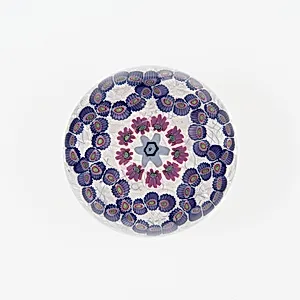
This paperweight uses a traditional glass-making technique called millefiori to great effect. Italian for “one thousand flowers,” millefiori was first developed in fifteenth-century Venice. In the nineteenth century, French glassmakers revived the technique with a cultural twist. Arranged to evoke traditional French gardens such as the Tuileries in Paris, paperweights like this example brought a little of this landscaping magic indoors. From the late 1840s to early 1860s, French manufacturers o...
Art Historical Context
This exquisite glass paperweight from the Clichyhouse, dating to around 1845–60, exemplifies the golden age of French glassmaking in the mid-19th century. at the renowned La Fabrique de Cristal Clichy near Paris, it measures just 7. cm in diameter—perfectly sized for a desk accessory that doubled as a collector's treasure. Clichy was one of Europe's premier producers of paperweights during this era, rivaling Baccarat and Saint-Louis in innovation and craftsmanship. Paperweights emerged as a functional art form in the 1840s, born from advances in glassblowing and lampworking techniques. Clichy's artisans mastered intricate methods like millefiori (thousand flowers), where colorful glass rods were fused into complex patterns, often featuring signature white and red roses or concentric designs. This piece highlights the Applied Arts of Europe tradition, blending utility with opulent decoration amid the Industrial Revolution's embrace of decorative objects. Housed in the Art Institute of Chicago, this paperweight invites visitors to appreciate how everyday items became canvases for artistic virtuosity, preserving Clichy's legacy before the factory's closure in the 1870s. A delightful glimpse into Victorian-era ingenuity!
About the Artist
Clichy Glasshouse · 1837–1885
The Verrerie de Clichy, also known as the Clichy Glasshouse or Cristalleries de Clichy, was established in 1837 through the merger of local glassworks at Billancourt near Paris, under the direction of Rouyer and Maes. The firm relocated to Clichy-la-Garenne in 1839, where it initially produced utilitarian items like bottles and tableware before pivoting to luxury glass objects amid France's burgeo...