
Paperweight
c. 1845–60
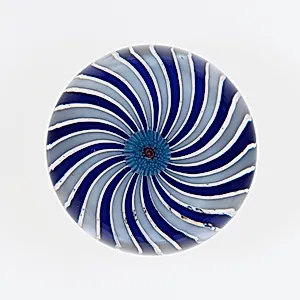
Medium
Glass
Dimensions
Diam.: 7.6 cm (3 in.)
Classification
paperweight
Department
Applied Arts of Europe
Museum
Art Institute of Chicago
Accession Number
188219
Rights
Public Domain
Art Historical Context
This charming glass paperweight, crafted the esteemed Clichy Glasshouse around 1845–60, captures the pinnacle of mid-19th-century French arts. At just 3 inches (7.6 cm) in diameter, served as both a practical desk accessory—anchoring loose papers against drafts—and a sparkling jewel for Victorian parlors and studies. Produced near Paris during the height of the Industrial Revolution, Clichy's works reflect the era's fusion of utility and opulence in applied arts. Clichy Glasshouse was one of France's premier makers of paperweights, rivaling Baccarat and Saint-Louis in innovation. Their pieces often showcased masterful lampworking techniques, embedding colorful glass canes or motifs within a clear, domed form to create mesmerizing depth and magnification. This example, now in the Art Institute of Chicago's Department of Applied Arts of Europe, exemplifies how such diminutive objects democratized luxury, adorning bourgeois homes and underscoring France's dominance in glass artistry. A testament to technical precision and aesthetic delight, the paperweight invites closer inspection, revealing the glassmakers' skill in balancing form, function, and fanciful design.
About the Artist
Clichy Glasshouse · 1837–1885
The Verrerie de Clichy, also known as the Clichy Glasshouse or Cristalleries de Clichy, was established in 1837 through the merger of local glassworks at Billancourt near Paris, under the direction of Rouyer and Maes. The firm relocated to Clichy-la-Garenne in 1839, where it initially produced utilitarian items like bottles and tableware before pivoting to luxury glass objects amid France's burgeo...