
Paperweight
c. 1848–55
Medium
Glass
Dimensions
Diam.: 9.2 cm (3 5/8 in.)
Classification
paperweight
Department
Applied Arts of Europe
Museum
Art Institute of Chicago
Accession Number
54871
Rights
Public Domain
About this artwork
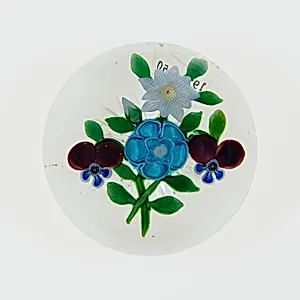
Technological improvements to optical scientific instruments in the mid-nineteenth century spurred a veritable obsession across Europe with identifying and classifying the natural world. Amateur botanists were eager to collect and preserve floral specimens, which they intently researched and catalogued. In response to this broad appeal, French glassmakers made paperweights that portrayed the very botanical subjects that were so enthusiastically sought. Many weights represented specimens with hor...
Art Historical Context
This charming glass paperweight from Baccarat Glassworks, dating to around 1848–55, exemplifies the pinnacle of-19th-century French craftsmanship. Measuring just 3⅝ inches in diameter, hails from the golden age of paperweights, when the burgeoning middle class embraced these functional desk ornaments as symbols of refinement. Baccarat, founded in 1764 in Lorraine,, rose to prominence for its flawless crystal, leveraging cutting-edge furnace techniques to produce vibrant, durable glass that captured light like no other. The paperweight's creation coincides with the peak of the classic French paperweight era (1845–65), a brief but brilliant period driven by innovation in glassmaking. Artisans at Baccarat mastered complex methods like millefiori—arranging tiny, colorful glass canes into intricate patterns—and lampworking, embedding flowers, fruits, or even portraits within clear domes. This piece, housed in the Art Institute of Chicago's Department of Applied Arts of Europe, highlights how such objects blurred the line between utility and art, showcasing the era's technological prowess and aesthetic elegance. Today, Baccarat paperweights remain collector's treasures, their clarity and detail a testament to an artisanal tradition that influenced global design. Imagine it holding down letters amid the gaslit studies of Victorian Europe—a tiny jewel of industrial artistry.
About the Artist
Baccarat Glassworks
Baccarat Glassworks, founded in 1764 in the Lorraine village of Baccarat, France, emerged from a royal decree by King Louis XV granting Bishop Monseigneur de Montmorency-Laval permission to establish a glass factory. Leveraging abundant local driftwood from the Vosges forest and skilled craftsmen, the works initially produced soda glass for windows, mirrors, and everyday stemware, employing thousa...