
Paperweight
c. 1848–55
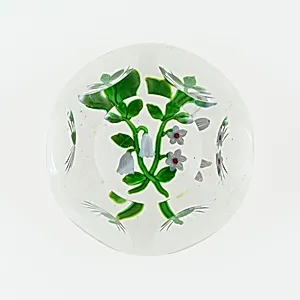
Medium
Glass
Dimensions
Diam.: 7 cm (2 3/4 in.)
Classification
paperweight
Department
Applied Arts of Europe
Museum
Art Institute of Chicago
Accession Number
58933
Rights
Public Domain
About this artwork
Technological improvements to optical scientific instruments in the mid-nineteenth century spurred a veritable obsession across Europe with identifying and classifying the natural world. Amateur botanists were eager to collect and preserve floral specimens, which they intently researched and catalogued. In response to this broad appeal, French glassmakers made paperweights that portrayed the very botanical subjects that were so enthusiastically sought. Many weights represented specimens with hor...
Art Historical Context
Nestled in the Applied Arts of Europe department at the Art Institute of Chicago this charming *Paperweight* from Baccarat Glassworks (c. 1848–55) the elegance of mid-19th-century craftsmanship. Measuring just 7 cm in diameter its compact glass form was designed as both a functional desk accessory and a showcase of luxury, reflecting the era's fascination with refined household objects. Baccarat, founded in 1764 in Lorraine, France, rose to prominence as a premier crystal manufacturer, earning imperial commissions and international acclaim. The 1840s–1850s marked the golden age of French paperweights, spurred by the popularity of enclosed postal systems and the need to secure loose papers. Baccarat, alongside factories like Saint-Louis and Clichy, pioneered this art form, producing over a million examples that blended utility with artistry. Crafted from high-quality lead crystal, the paperweight exemplifies advanced glassmaking techniques, such as precise cutting and polishing to achieve clarity and sparkle. Its historical significance lies in democratizing opulence—once a novelty for the elite, these pieces adorned desks worldwide, symbolizing industrial innovation and Victorian taste. A true gem for collectors!
About the Artist
Baccarat Glassworks
Baccarat Glassworks, founded in 1764 in the Lorraine village of Baccarat, France, emerged from a royal decree by King Louis XV granting Bishop Monseigneur de Montmorency-Laval permission to establish a glass factory. Leveraging abundant local driftwood from the Vosges forest and skilled craftsmen, the works initially produced soda glass for windows, mirrors, and everyday stemware, employing thousa...