
Paperweight
19th century
Medium
Glass
Dimensions
H.: 7.7 cm (3 in.)
Classification
paperweight
Department
Applied Arts of Europe
Museum
Art Institute of Chicago
Accession Number
94445
Rights
Public Domain
About this artwork
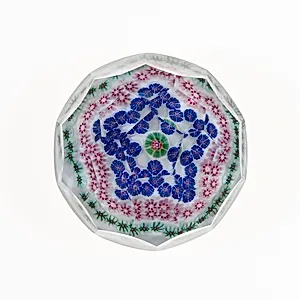
This paperweight uses a traditional glass-making technique called millefiori to great effect. Italian for “one thousand flowers,” millefiori was first developed in fifteenth-century Venice. In the nineteenth century, French glassmakers revived the technique with a cultural twist. Arranged to evoke traditional French gardens such as the Tuileries in Paris, paperweights like this example brought a little of this landscaping magic indoors. From the late 1840s to early 1860s, French manufacturers o...
Art Historical Context
This elegant glass paperweight from the Clichy Glass exemplifies the pinnacle of 19th-century French glassmaking artistry. Produced during the height of the Industrial Revolution, when desk accessories surged in popularity following the advent of the postage stamp in 1840, Clichy—based near Paris—was renowned for its innovative paperweights. Standing at just 7.7 cm (3 in.) tall, this compact object from the Art Institute of Chicago's Applied Arts Europe department transforms a utilitarian item into a dazzling display of craftsmanship. Crafted in glass, the medium allowed Clichy artisans to employ sophisticated techniques like millefiori (thousand flowers), where colorful glass rods are sliced and arranged into intricate patterns encased in a clear dome. These paperweights were not mere tools but collectible treasures, showcasing optical precision and vibrant hues that captured light beautifully. Clichy's output, peaking in the 1840s–1860s, helped establish paperweights as a hallmark of Victorian decorative arts. Today, this piece highlights the fusion of functionality and fine art in Europe's applied arts tradition, inviting visitors to appreciate how everyday objects embodied luxury and ingenuity in the 19th century.
About the Artist
Clichy Glasshouse · 1837–1885
The Verrerie de Clichy, also known as the Clichy Glasshouse or Cristalleries de Clichy, was established in 1837 through the merger of local glassworks at Billancourt near Paris, under the direction of Rouyer and Maes. The firm relocated to Clichy-la-Garenne in 1839, where it initially produced utilitarian items like bottles and tableware before pivoting to luxury glass objects amid France's burgeo...