
Papyrus Fragment
Unknown Artist
dated A.H. 288/ 901 CE
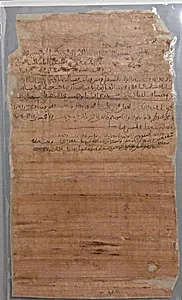
Medium
Ink on papyrus
Dimensions
H. 19 1/2 in. (49.5 cm) W. 12 3/8 in. (31.5 cm)
Classification
Codices
Department
Islamic Art
Museum
Metropolitan Museum of Art, New York, NY
Credit
Gift of Florence E. and Horace L. Mayer, 1978
Accession Number
1978.348.1a
Rights
Public Domain
Tags
Art Historical Context
This delicate Papyrus Fragment, dated to A.H. 288 (901 CE), offers a rare glimpse into the early Islamic world through its ink inscriptions on ancient Egyptian papyrus. Measuring 19½ by 12⅜ inches (49.5 by 31.5 cm), it survives as a page from a codex—a bound book format that revolutionized manuscript production in the Islamic tradition. Housed in the Metropolitan Museum of Art's Department of Islamic Art, this piece was generously gifted by Florence E. and Horace L. Mayer in 1978. Crafted with precise ink calligraphy, the fragment exemplifies the artistry of anonymous scribes during the Abbasid era, when papyrus remained a primary medium in Egypt before paper's dominance. Such documents, often administrative or textual records, illuminate daily life, governance, and scholarship under early Muslim rule, bridging classical antiquity and medieval Islam. For visitors, this artifact whispers of a vibrant scribal culture where every stroke held cultural weight, preserving knowledge across centuries. Its survival underscores papyrus's fragility and the enduring value of Islamic codices in understanding history's quiet custodians.