
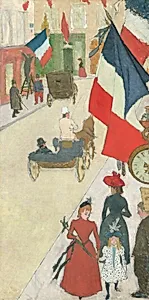
Paris, Rue de Parme on Bastille Day
1890
Medium
oil on canvas
Dimensions
overall: 79.2 x 40.3 cm (31 3/16 x 15 7/8 in.) framed: 93.4 x 54.3 x 3.2 cm (36 3/4 x 21 3/8 x 1 1/4 in.)
Classification
Painting
Department
CMC
Museum
National Gallery of Art, Washington, D.C.
Credit
Collection of Mr. and Mrs. Paul Mellon
Accession Number
1995.47.2
Rights
Public Domain
Art Historical Context
Pierre Bonnard painted “Paris, Rue de Parme on Bastille” in 1890, when he was only twenty-three. Executed in oil on canvas, the tall, narrow composition records a festive Parisian street scene on July 14, the national holiday marking the French Revolution. At this early moment in his career, Bonnard was already drawn to the everyday rhythms of modern city life, transforming an ordinary neighborhood into a quietly celebratory image. Bonnard belonged to the Nabis, a circle of young artists who favored simplified forms, strong color, and decorative surfaces over strict realism. In this work the vertical format emphasizes the bustling verticality of the street, while the oil medium allowed him to layer luminous tones that suggest sunlight, flags, and movement without precise detail. The result captures both the public joy of Bastille Day and the intimate, almost snapshot-like quality that would become a hallmark of Bonnard’s vision. Acquired by Mr. and Mrs. Paul Mellon and now in the collection of the National Gallery of Art, the painting offers today’s viewers a vivid glimpse of late-nineteenth-century Paris through the eyes of one of its most poetic chroniclers.
About the Artist
Pierre Bonnard · 1867–1947
Pierre Bonnard (1867–1947) was a French painter and printmaker who became a leading figure in the Post-Impressionist movement and a founding member of Les Nabis. Born on October 3, 1867, in Fontenay-aux-Roses, France, Bonnard initially studied law at his father's insistence, graduating and briefly practicing as a barrister in 1888. However, his true passion lay in art, and he had simultaneously at...