
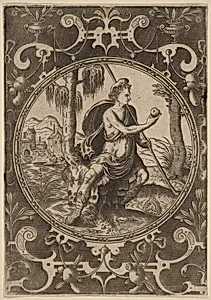
Paris with the Apple
Medium
engraving on laid paper
Dimensions
sheet (trimmed to plate mark): 11 × 7.2 cm (4 5/16 × 2 13/16 in.)
Classification
Department
CG-E
Museum
National Gallery of Art, Washington, D.C.
Credit
Anonymous gift in memory of Charles B. Hoyt
Accession Number
1950.2.1
Rights
Public Domain
Art Historical Context
This small engraving, created by an anonymous Netherlandish artist between 1501 and 1550, depicts the Trojan prince Paris holding the golden apple central to the ancient Greek myth of the Judgment Paris. Once attributed to the Flemish engraver Abraham de Bruyn, the work reflects the Northern Renaissance fascination with classical mythology, which Northern European artists reinterpreted through a distinctly local lens. The compact size—roughly the dimensions of a playing card—suggests it was designed for intimate viewing, perhaps as part of a collector’s album or as an illustration for printed books. Engraving on laid paper allowed for remarkably fine lines and subtle shading, techniques that flourished in the Low Countries during this period. Such prints played a vital role in spreading Renaissance ideas across Europe, making mythological narratives accessible beyond courtly or ecclesiastical circles. The anonymous artist’s precise handling of the figure and drapery demonstrates the high level of craftsmanship typical of Netherlandish printmakers, even when working on a modest scale. Housed in the National Gallery of Art, this impression was given anonymously in memory of Charles B. Hoyt. It offers today’s visitors a window into how 16th-century audiences encountered ancient stories through the innovative medium of print.