
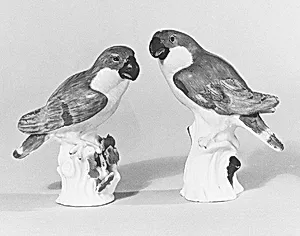
Parrot (one of a pair)
Medium
Hard-paste porcelain
Dimensions
Height: 4 3/8 in. (11.1 cm)
Classification
Ceramics-Porcelain
Culture
German, Meissen
Department
European Sculpture and Decorative Arts
Museum
Metropolitan Museum of Art, New York, NY
Credit
The Lesley and Emma Sheafer Collection, Bequest of Emma A. Sheafer, 1973
Accession Number
1974.356.405
Rights
Public Domain
Tags
Art Historical Context
This delightful porcelain parrot, crafted around 1741 by the Me Manufactory with modeling by Johann Joachim Känd, exemplifies the golden age of European porcelain artistry. Standing just 4 3/8 inches tall, it forms one of a pair of lifelike bird figurines, showcasing Meissen's mastery of hard-paste porcelain—a material developed in Germany in 1710, which rivaled China's coveted "white gold" for its translucency and durability. Kändler, Meissen's chief sculptor from 1733, brought Rococo flair to these pieces with his keen observation of nature, capturing the parrot's vibrant feathers, poised stance, and intricate details through meticulous hand-molding and painting. Produced at the Saxon factory near Dresden, these figurines were prized by European aristocracy as table decorations or cabinet treasures, symbolizing wealth and whimsy amid the Enlightenment's fascination with exotic animals. Today, this parrot graces The Metropolitan Museum of Art's European Sculpture and Decorative Arts collection, part of The Lesley and Emma Sheafer Collection (1973). It invites visitors to marvel at how Meissen elevated ceramics into high art, blending technical innovation with playful realism.
About the Artist
Meissen Manufactory|Johann Joachim Kändler · 1710–present
The Meissen Manufactory, established on June 6, 1710, by Augustus the Strong, Elector of Saxony and King of Poland, marked the dawn of true hard-paste porcelain production in Europe. Nestled at Albrechtsburg Castle in Meissen near Dresden, the Royal Polish and Electoral Saxon Porcelain Manufactory arose from alchemical experiments begun in 1708 by physicist Ehrenfried Walther von Tschirnhaus and p...