
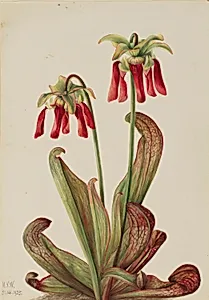
Parrot Pitcherplant (Sarracenia psittacina)
Medium
Painting
Classification
Painting
Department
Smithsonian Collection
Museum
Smithsonian American Art Museum
Credit
Smithsonian American Art Museum, Gift of the artist
Accession Number
1970.355.574
Rights
Public Domain
Tags
Art Historical Context
Mary Vaux Walcott'sParrot Pitcherplant (Sarrac psittacina)*, painted in 1925, the delicate allure of this carnivorous plant native to the wetlands of the southeastern United States. Walcott, a pioneering botanist and artist, rendered the plant's distinctive hooded pitchers—reminiscent of a parrot's beak—in exquisite detail, showcasing her mastery of watercolor techniques. Donated by the artist herself to the Smithsonian American Art Museum, work exemplifies the intersection of art and science in early 20th-century America. As the wife of Smithsonian Secretary Charles Doolittle Walcott, Mary Vaux Walcott produced over a thousand precise botanical illustrations during her lifetime, often trekking through remote wilderness to document North American wildflowers. Her paintings, including this one from the Smithsonian Collection, were not mere decorations but scientific tools, aiding botanists in identifying and studying species like the *Sarracenia psittacina*, which lures insects into its submerged traps. This piece highlights the era's growing appreciation for natural history illustration, blending artistic beauty with empirical accuracy. Visitors to the Smithsonian will appreciate how Walcott's gift immortalizes the pitcherplant's subtle colors and intricate forms, inviting reflection on nature's ingenuity and the artist's dual legacy in art and exploration.