
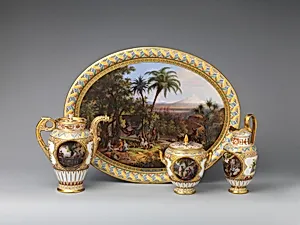
Partial coffee service (Déjeuner “Culture et Récolte du cacao”)
Medium
Hard-paste porcelain decorated in polychrome enamels, gold
Dimensions
Coffeepot: overall (confirmed): 7 9/16 x 6 15/16 x 4 1/4 in. (19.2 x 17.6 x 10.8 cm); Milk jug: overall (confirmed): 7 7/16 x 3 7/8 x 3 1/4 in. (18.9 x 9.8 x 8.3 cm); Sugar bowl: overall (confirmed): 5 5/8 x 5 1/4 x 4 1/16 in. (14.3 x 13.3 x 10.3 cm); Tray: overall (confirmed): 3/4 x 17 3/4 x 13 11/16 in. (1.9 x 45.1 x 34.8 cm)
Classification
Ceramics-Porcelain
Culture
French, Sèvres
Department
European Sculpture and Decorative Arts
Museum
Metropolitan Museum of Art, New York, NY
Credit
Purchase, The Charles E. Sampson Memorial Fund and Gift of Irwin Untermyer, by exchange, 1986
Accession Number
1986.281.1a, b–.4
Rights
Public Domain
Tags
Art Historical Context
This exquisite partial coffee service, titledDéjeuner “Culture etcolte du cacao” (Coffee Service “Cultivation and Harvest of C”), was crafted in 1836 at the renowned Sèvres Porcelain Manufactory in. Designed by Jean Charles Develly, with gilding by Pierre R, it reflects the opulence of the July Monarchy under King Louis Philippe. Produced as a luxury set—including a coffeepot, milk jug, sugar bowl, and—this hard-paste porcelain ensemble showcases Sèvres' mastery in creating durable, translucent wares fit for royal tables. Vibrantly decorated in polychrome enamels and lavish gold, the service features detailed scenes of cacao cultivation and harvest. Landscapes teeming with men and women engaged in industry evoke France's colonial trade in cocoa from the Caribbean, blending pastoral beauty with economic symbolism. The enameling technique—firing colored glazes at low temperatures—allowed for painterly precision, rivaling fine canvas art on fragile porcelain. A highlight of European decorative arts, this set at the Metropolitan Museum of Art underscores Sèvres' role as a state-sponsored innovator, blending artistry with imperial narrative during an era of expanding global commerce. Imagine sipping coffee amid these vivid vignettes—a taste of 19th-century refinement!