
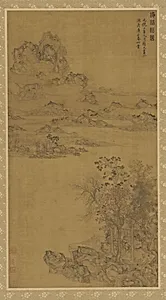
Parting from a Friend under Autumn Trees
17th-18th century
Classification
Painting
Department
Smithsonian Collection
Museum
Smithsonian American Art Museum
Credit
Gift of Charles Lang Freer
Accession Number
F1915.29
Rights
Public Domain
Tags
About this artwork
To 1915
Art Historical Context
"Parting from a Friend under Trees," attributed to the Qing dynasty artist Gu Fuzhen (1634–ca. 1716), captures a poignant moment of farewell amid the vivid hues of autumn foliage. Created in the 17th or 18th century during China's Qing era (1644–1911), this painting reflects the literati tradition of evoking nature's beauty intertwined with human emotion. Autumn trees, with their fleeting colors, symbolize transience and melancholy—common motifs in Chinese art that resonate with Confucian and Daoist ideals of life's impermanence. Gu Fuzhen, active in the vibrant artistic circles of Nanjing, blended meticulous brushwork with expressive landscapes, often depicting scholarly figures in contemplative scenes. Though the exact medium is unknown, such works typically employed ink and subtle colors on silk or paper, allowing for delicate layers of atmosphere and depth. The title evokes the classical theme of parting, a staple in poetry and painting, inviting viewers to ponder friendship's fragility against nature's cycles. Generously gifted to the Smithsonian American Art Museum by collector Charles Lang Freer by 1915, this piece highlights the bridge between Chinese artistic heritage and American audiences. Part of the esteemed Freer collection, it offers a window into Qing China's refined aesthetic, where every leaf and gesture tells a story of quiet sorrow and enduring bonds.