
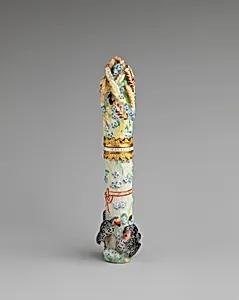
Partridges in wheatsheaf
ca. 1755
Medium
Soft-paste porcelain
Dimensions
Overall: 4 1/2 × 3/4 in. (11.4 × 1.9 cm)
Classification
Ceramics-Porcelain
Culture
British, Chelsea
Department
European Sculpture and Decorative Arts
Museum
Metropolitan Museum of Art, New York, NY
Credit
Gift of Irwin Untermyer, 1964
Accession Number
64.101.684a, b
Rights
Public Domain
Tags
Art Historical Context
Nestled among the delicate fronds of a wheatsheaf, two plump partridges perch in this charming porcelain figurine from the Chelsea Porcelain Manactory, circa 1755. Crafted from soft-paste porcelain—a British blend of clay and ground glass fired at lower temperatures—this petite piece (just 4½ × ¾ inches) showcases the factory's mastery of intricate modeling and vibrant enameling. The birds' feathers, rendered with lifelike texture, and the surrounding wheat, leaves, and subtle floral accents evoke the natural abundance of the English countryside, blending whimsy with realism. Chelsea, one of England's pioneering porcelain works founded in the 1740s, produced such decorative objects during its early "gold anchor" period, rivaling elite European makers like Meissen. Soft-paste allowed for the fine details and jewel-toned glazes that made these items coveted by 18th-century collectors, symbolizing wealth and refined taste. This example, a gift to the Metropolitan Museum of Art in 1964, highlights the rococo-era fascination with nature motifs, transforming everyday scenes into exquisite tabletop ornaments that delighted Georgian drawing rooms.
About the Artist
Chelsea Porcelain Manufactory · 1744–1784
**Chelsea Porcelain Manufactory** The Chelsea Porcelain Manufactory, Britain's pioneering porcelain enterprise, was founded around 1743 in Chelsea, London, by two Huguenot silversmiths: Nicholas Sprimont from Liège and Charles Gouyn. Sprimont, trained in Paris as a goldsmith before immigrating to England, brought his expertise in luxury metalwork to the venture, while Gouyn handled early sales th...