
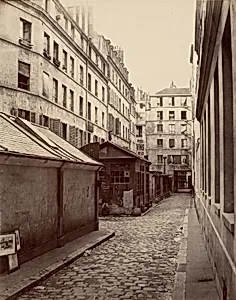
Passage des Deux-Soeurs de la rue Lafayette
c. 1867
Medium
albumen print
Dimensions
image/sheet: 34.3 × 27.2 cm (13 1/2 × 10 11/16 in.) overall: 71.12 × 55.88 cm (28 × 22 in.)
Classification
Photograph
Department
CPH
Museum
National Gallery of Art, Washington, D.C.
Credit
Robert B. Menschel Fund
Accession Number
1997.61.2
Rights
Public Domain
Art Historical Context
Step into the shadowy intimacy of 19th-century Paris with Charles Marville's *Passage des Deux-Soe de la rue Lafayette* (c. 1867), an evocative albumen print capturing a narrow alleyway off the bustling Rue Lafayette. Marville, Paris's official photographer under Napoleon III, masterfully documented the city's labyrinthine old quarters with crisp detail, preserving fleeting glimpses of everyday life amid looming urban change. This 34.3 × 27.2 cm image reveals the textured stone walls, arched doorways, and quiet passage that defined working-class neighborhoods—intimate spaces soon to vanish. Created during Baron Haussmann's grand renovation of Paris (1853–1870), the photograph holds profound historical significance as a visual archive. Commissioned by the city, Marville's work recorded over 400 sites before their demolition for wide boulevards and modern infrastructure, offering invaluable insight into pre-modern Paris. The albumen process, using egg-white sensitized paper, yields the print's luminous tones and sharp clarity, highlighting subtle plays of light and shadow that evoke a sense of nostalgia and transience. Today, housed in the National Gallery of Art (Robert B. Menschel Fund, CPH Department), this piece bridges art and history, reminding us how photography captured the pulse of a transforming metropolis. It's a poignant testament to Marville's documentary precision and the cultural heartbeat of old Paris.
About the Artist
Charles Marville · 1813–1879
**Charles Marville**, born Charles François Bossu on July 17, 1813, in Paris, adopted his professional pseudonym around 1832 to avoid the stigma of "bossu," meaning hunchback in French. Trained as a painter, engraver, and illustrator, he spent nearly two decades producing woodblock illustrations for books and magazines before embracing photography around 1850. His transition coincided with the med...