
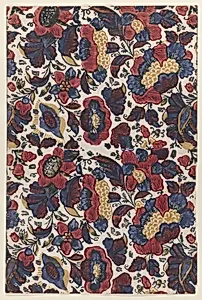
Paste end paper with overall pattern of red, blue, and yellow flowers
19th century
Medium
Relief print (wood or metal)
Dimensions
Sheet: 10 3/16 × 15 3/8 in. (25.9 × 39 cm)
Classification
Prints
Department
Drawings and Prints
Museum
Metropolitan Museum of Art, New York, NY
Credit
The Elisha Whittelsey Collection, The Elisha Whittelsey Fund, 1966
Accession Number
66.628.1
Rights
Public Domain
Art Historical Context
This charming 19th-century paste endpaper, produced by the renowned Remondini Family of Italian printers, showcases an exuberant all-over pattern of red,, and yellow flowers. 10 3/16 × 15 3/8 inches, it exemplifies the decorative papers crafted for the insides of book covers, transforming humble bindings into visual delights. The anonymous design reflects the Remondini workshop's legacy in Bassano del Gr, where generations specialized in vibrant, repeatable motifs for books, stationery, and more. Created via relief printing—a technique using carved wood or metal blocks inked and pressed onto paper—these endpapers highlight the precision and efficiency of 19th-century printmaking. The bold floral palette and rhythmic pattern demonstrate how relief methods allowed for affordable, high-volume production, blending artistry with industrial innovation. Flowers symbolized beauty and renewal in Victorian-era aesthetics, making such papers a subtle luxury in everyday reading. Housed in the Metropolitan Museum of Art's Drawings and Prints department as part of The Elisha Whittelsey Collection (acquired 1966), this piece offers a window into the unsung craft of decorative printing. It reminds us how anonymous artisans elevated the ordinary, infusing books with color and joy for 19th-century audiences.
About the Artist
Anonymous|Remondini Family
In the vast tapestry of art history, "Anonymous" stands not as a singular individual but as a collective designation for countless unidentified creators whose works have endured across millennia. These artists, spanning prehistoric cave painters to medieval illuminators and folk craftsmen, produced the foundational layers of human visual culture. Prior to the Renaissance, when individual fame emer...