
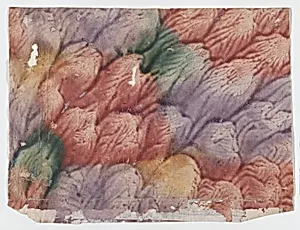
Paste paper with red, purple, yellow, and green design
18th century
Medium
Relief print (wood or metal)
Dimensions
Sheet: 5 1/2 × 7 5/16 in. (14 × 18.5 cm)
Classification
Prints
Department
Drawings and Prints
Museum
Metropolitan Museum of Art, New York, NY
Credit
Harris Brisbane Dick Fund, 1926
Accession Number
26.71.9(130a)
Rights
Public Domain
Art Historical Context
This vibrant 18th-century paste, featuring a lively design in red, purple, yellow, green, exemplifies the anonymous artistry of European decorative crafts. Created through relief printing—likely using carved wood or metal blocks—the small sheet (5 1/2 × 7 5/16 in.) captures, repeating patterns brushed with colored paste onto handmade paper. Paste papers like this were a hallmark of workshops in Germany, France, and beyond, where artisans produced affordable, eye-catching sheets for bookbinding, endpapers, and. The technique involved dipping stamps or rollers into pigmented paste, then pressing them onto damp paper to create textured, marbled effects. This hands-on process, blending printmaking with folk decoration, democratized beauty in everyday objects during the Enlightenment era, when printed books proliferated. Though anonymous, such works highlight skilled, uncredited labor that influenced later designers like William Morris. Acquired through the Harris Brisbane Dick Fund in 1926, this piece from the Metropolitan Museum of Art's Drawings and Prints department preserves a fleeting craft. It invites us to appreciate the joy in humble materials, bridging fine art and functional design.
About the Artist
Anonymous
In the vast tapestry of art history, "Anonymous" stands not as a singular individual but as a collective designation for countless unidentified creators whose works have endured across millennia. These artists, spanning prehistoric cave painters to medieval illuminators and folk craftsmen, produced the foundational layers of human visual culture. Prior to the Renaissance, when individual fame emer...