
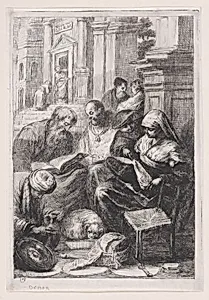
Pastiche in the manner of Bassano
18th–early 19th century
Medium
Etching
Dimensions
Sheet: 8 3/16 × 5 11/16 in. (20.8 × 14.5 cm)
Classification
Prints
Department
Drawings and Prints
Museum
Metropolitan Museum of Art, New York, NY
Credit
Gift of Harry G. Friedman, 1957
Accession Number
57.658.101
Rights
Public Domain
Art Historical Context
Visitors to the Metropolitan Museum of's Drawings and Prints department will delight in *Pastiche in the of Bassano*, an by Baron Dominique Vivanton from the 18th to early 19th. Measuring a compact 8 3/16 × 5 11/16 inches, this gifted work from Harry G. Friedman in 1957 exemplifies Denon's skill as a French artist, diplomat, and Louvre director under Napoleon. A pastiche is a playful imitation honoring another master's style, here channeling the Venetian Renaissance painter Jacopo Bassano (Jacopo da Ponte, c. 1510–1592). Bassano was renowned for his earthy, Mannerist scenes of rural life, shepherds, and animals rendered with dramatic light and vivid realism, bridging Renaissance tradition with emerging naturalism. Denon, a polymath engraver, captured this essence through etching—a precise intaglio technique using acid to bite lines into a metal plate, yielding rich tonal contrasts ideal for copying old masters. Created amid the Enlightenment's revival of classical art, it reflects how 18th-century artists paid homage to predecessors while advancing printmaking's accessibility. This piece highlights printmaking's cultural role in disseminating artistic ideas across Europe, bridging centuries. Spot the Bassano hallmarks in its pastoral vibe, a testament to enduring influences in art history. (198 words)