
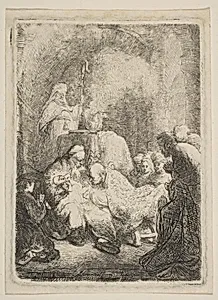
The Circumcision: Small Plate
ca. 1630
Medium
Etching and touches of drypoint
Dimensions
Sheet: 3 13/16 × 2 13/16 in. (9.7 × 7.2 cm) Plate: 3 9/16 × 2 5/8 in. (9.1 × 6.7 cm)
Classification
Prints
Department
Drawings and Prints
Museum
Metropolitan Museum of Art, New York, NY
Credit
Gift of Mr. and Mrs. Daniel B. Fuller, 1957
Accession Number
57.602.4
Rights
Public Domain
Tags
Art Historical Context
Rembrandt van Rijn'sThe Circumcision: Small Plate* (ca. 1630) captures a pivotal biblical moment from the Gospel of Luke, depicting the ritual circumcision of the infant Jesus his eighth day, surrounded by attendants including the Virgin Mary and Joseph. Created early in Rembrandt's career during the Dutch Golden Age, intimate print reflects the artist's deep engagement with religious narratives, blending profound spirituality with everyday human tenderness—a hallmark of his Baroque style. Masterfully executed in etching with subtle touches of drypoint, the work showcases Rembrandt's innovative printmaking techniques. Etching allowed for precise lines and intricate details in the small format (just under 4 by 3 inches), while drypoint added velvety burrs for dramatic light and shadow, evoking a sense of sacred glow amid the figures' clustered forms. This combination produced rich tonal depth, making the "small plate" edition a gem among his over 300 prints. Housed in the Metropolitan Museum of Art as a 1957 gift, this piece highlights Rembrandt's genius for transforming miniature scenes into emotionally resonant masterpieces, inviting viewers to contemplate faith and family in 17th-century Europe.
About the Artist
Rembrandt (Rembrandt van Rijn) · 1606–1669
Rembrandt Harmenszoon van Rijn (1606–1669) stands as one of the greatest visual artists in the history of Western art and the most important Dutch painter of the 17th century. Born in Leiden to a prosperous miller's family, Rembrandt transformed painting through his revolutionary use of light and shadow, his psychological depth in portraiture, and his elevation of etching to a fine art. His approx...