
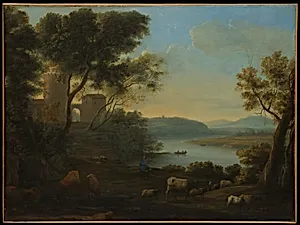
Pastoral Landscape: The Roman Campagna
ca. 1639
Medium
Oil on canvas
Dimensions
40 x 53 1/2 in. (101.6 x 135.9 cm)
Classification
Paintings
Department
European Paintings
Museum
Metropolitan Museum of Art, New York, NY
Credit
Bequest of Adele L. Lehman, in memory of Arthur Lehman, 1965
Accession Number
65.181.12
Rights
Public Domain
Tags
Art Historical Context
Claude Lorrain, a French-born master of the Baroque era who spent most of his career in Rome painted *Pastoral Landscape: The Romanagna* around 1639. This oil on canvas captures the idyllic beauty of the Roman countryside, or Campagna, with its expansive rivers, grazing cows, and sun-drenched vistas. Lorrain drew inspiration from the actual landscapes surrounding Rome, blending observation with imagination to create harmonious, timeless scenes that evoke classical antiquity. Renowned for pioneering the classical landscape genre, Lorrain excelled in atmospheric effects, using subtle gradations of light and color to suggest vast depth and the golden glow of late afternoon. His technique—layered glazes over precise underdrawings—brings a luminous serenity to the composition, where humble pastoral elements like herds and waterways take center stage without human drama. This work exemplifies his influence on European landscape painting, prioritizing nature's poetry over narrative. Now at the Metropolitan Museum of Art through the bequest of Adele L. Lehman, this 40 x 53½-inch masterpiece invites visitors to wander mentally through Rome's timeless fields, reminding us of 17th-century artists' quest to idealize the eternal city.
About the Artist
Claude Lorrain (Claude Gellée) · 1604–1682
Claude Gellée was born around 1600 in the village of Chamagne in the Duchy of Lorraine, from which he would take the professional name by which history knows him: Claude Lorrain. Orphaned young, he traveled south to Rome as a teenager, eventually finding his way into the Naples workshop of Goffredo Wals before apprenticing with the Roman landscapist and fresco painter Agostino Tassi around 1622. F...