
Pastorale
1756 - 1776
Medium
crayon manner
Dimensions
231; 165
Rights
Public Domain
About this artwork
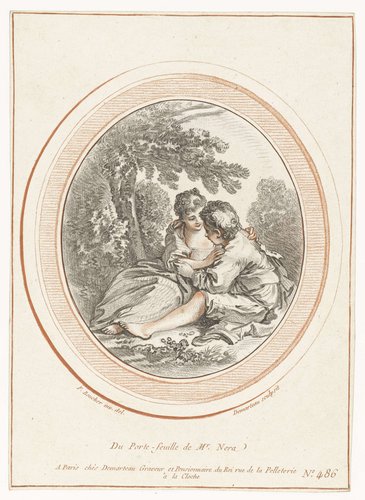
opschrift, reco midden onder, etsen: ‘Du Porte-feuille de Mr. Nera’
Art Historical Context
Created between 1756 and 1776, *Pastorale* exemplifies the refined elegance of eighteenth-century French printmaking. Gilles Demarteau, a leading engraver in Paris, specialized in the crayon manner technique—a innovative etching process that skillfully mimics the soft, textured strokes of red and black chalk drawings. This allowed prints like *Pastorale* to capture the spontaneous, painterly quality of original sketches while making them widely accessible to collectors. The work’s title evokes the idyllic rural scenes popular during the Rococo era, when artists celebrated themes of nature, leisure, and rustic simplicity. Measuring just 231 by 165 millimeters, the intimate scale suits the delicate medium, inviting close viewing of its tonal subtleties. An inscription identifying it as “Du Porte-feuille de Mr. Nera” suggests it once belonged to a private portfolio, highlighting how such prints circulated among connoisseurs. Demarteau’s mastery helped elevate reproductive printmaking to an art form in its own right, bridging painting and drawing for a growing audience of enthusiasts across Europe.
About the Artist
Gilles Demarteau · 1729–1776
Gilles Demarteau the Elder, born on January 19, 1722, in Liège, began his career steeped in the craft of metalwork. The son of a gunsmith, he learned engraving and goldsmithing from his father before moving to Paris around 1748–1750 to join his brother, who worked as a goldsmith for the engraver De Lacollombe, renowned for firearm ornament designs. Demarteau trained in De Lacollombe's workshop as ...