
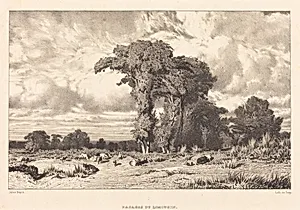
Pastures of Limousin (Pacages du Limousin)
1835
Medium
lithograph
Classification
Department
CG-E
Museum
National Gallery of Art, Washington, D.C.
Credit
Rosenwald Collection
Accession Number
1980.45.448
Rights
Public Domain
Art Historical Context
Jules Dupré’s 1835 lithograph *Pastures of Limousin* captures the quiet beauty of rural France through a medium that was transforming how art reached the public. Created early in Dupré’s career, the print depicts the rolling pastures of the Limousin region with a sensitive eye for light and atmosphere. As a lithograph, it allowed the artist to reproduce subtle tonal effects and textures that evoke the gentle movement of grass and sky, making the scene feel both intimate and expansive. Printmaking held special significance in the 1830s, offering an affordable way for wider audiences to own original compositions rather than relying solely on paintings seen in salons. Dupré’s choice of lithography reflects the period’s growing interest in everyday landscapes and the desire to bring the French countryside into homes and collections. This work, now part of the National Gallery of Art’s Rosenwald Collection, exemplifies how 19th-century artists used new reproductive techniques to share their vision of nature’s calm dignity with a broader public.
About the Artist
Jules Dupré · 1811–1889
Jules Dupré (1811–1889) was born in Nantes, France, on April 5, the son of a porcelain manufacturer. He began his artistic career in his father's factory before moving to paint porcelain at his uncle's china factory in Sèvres. Lacking formal training or a specific teacher, Dupré debuted at the Paris Salon in 1831, earning a second-class medal three years later. A pivotal trip to England in 1834 ex...