
Patch Pocket and Decorations on Ky. Rifle
1938
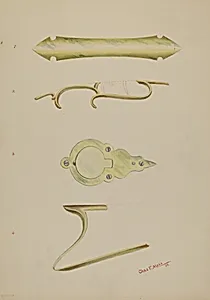
Medium
watercolor and graphite on paperboard
Dimensions
overall: 35.4 x 25.3 cm (13 15/16 x 9 15/16 in.)
Classification
Index of American Design
Department
CG-W
Museum
National Gallery of Art, Washington, D.C.
Credit
Index of American Design
Accession Number
1943.8.3627
Rights
Public Domain
Art Historical Context
Behold the intricate details of *Patch Pocket and Decorations Ky. Rifle*, a 1938 watercolor and graphite rendering by Charles Moss. Measuring 35.4 x 25.3 cm, this delicate work on paperboard captures the ornate patch pocket and embellishments of a classic Kentucky Rifle—a hallmark of 18th- and 19th-century Americanmithing from the Appalachian frontier. Moss's precise technique highlights the rifle's engraved silver inlays, floral motifs, and functional leather pocket, evoking the craftsmanship of early American longrifles prized for their accuracy and beauty. Created as part of the Index of American Design, a New Deal-era Federal Art Project under the Works Progress Administration (WPA), this piece belongs to a vast archive of over 15,000 watercolor renderings documenting everyday American folk art and design. Artists like Moss meticulously studied and illustrated objects in museums and private collections, preserving cultural heritage amid the Great Depression. Housed in the National Gallery of Art's Index of American Design collection, it celebrates the fusion of utility and artistry in frontier life. These renderings not only safeguarded vanishing traditions but also fueled a renewed appreciation for vernacular American aesthetics, influencing mid-20th-century design and patriotism. Step closer to admire how Moss's subtle watercolor washes and graphite lines bring the rifle's tactile elegance to life, a testament to our nation's inventive spirit.
About the Artist
Charles Moss · 1855–present
Charles Moss is an artist whose work appears in museum collections in notable quantity, attesting to a sustained and recognized practice even though the biographical details — his dates, nationality, and the particular tradition in which he was trained — have not been thoroughly recorded in the art-historical literature currently available. The name Charles Moss is common enough to pose identifica...