
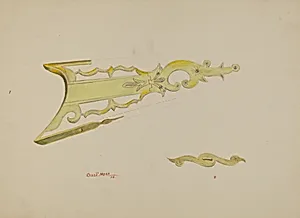
Patch Pocket, Butt Plate & Stock on Ky. Rifle
1938
Medium
watercolor and graphite on paperboard
Dimensions
overall: 25.3 x 35.5 cm (9 15/16 x 14 in.) Original IAD Object: 10" long; 3 3/4" wide
Classification
Index of American Design
Department
CG-W
Museum
National Gallery of Art, Washington, D.C.
Credit
Index of American Design
Accession Number
1943.8.3628
Rights
Public Domain
Art Historical Context
Created in 1938 by artist Charles Moss as part of the Federal Art Project's Index of American (IAD), *Patch Pocket, Butt Plate Stock on Ky. Rifle is a meticulous watercolor and graphite rendering on paperboard. This 25.3 x 35.5 cm (9 15/16 x 14 in.) work captures the intricate details of components from a classic Kentucky Rifle—a long rifle emblematic of 18th- and 19th-century American frontier life. The original object measured 10 inches long and 3 3/4 inches wide, the precision of Moss's scale model. The IAD, launched during the Great Depression under the Works Progress Administration (WPA), aimed to document and celebrate everyday American folk art and design through over 15,000 such renderings. Kentucky Rifles, handcrafted by German immigrant gunsmiths in Pennsylvania and Kentucky, were prized for their accuracy and ornate metalwork, symbolizing self-reliance and ingenuity on the expanding frontier. Moss's piece preserves these cultural artifacts amid rapid industrialization. Artistically, the watercolor evokes the rifle's polished wood grain and gleaming brass, while graphite adds fine lines for texture and form. Housed in the National Gallery of Art's collection, it invites us to appreciate the fusion of utility and artistry in America's material heritage.
About the Artist
Charles Moss · 1855–present
Charles Moss is an artist whose work appears in museum collections in notable quantity, attesting to a sustained and recognized practice even though the biographical details — his dates, nationality, and the particular tradition in which he was trained — have not been thoroughly recorded in the art-historical literature currently available. The name Charles Moss is common enough to pose identifica...