
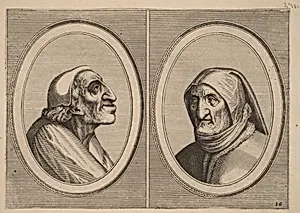
"Pater Muylaert" and "Mater Bille-bloots"
Medium
etching
Classification
Department
CG-E
Museum
National Gallery of Art, Washington, D.C.
Credit
Andrew W. Mellon Fund
Accession Number
1975.112.12
Rights
Public Domain
Art Historical Context
This etching, created around1564–1565 by Johannes and Lucas van Doetechum after a design by Pieter Bruegel the Elder, showcases the vibrant printmaking culture of the Northern Renaissance. Bruegel, celebrated for his sharp observations of everyday life and human folly, often collaborated with skilled engravers to translate his drawings into widely accessible prints. The van Doetechum brothers known for their precise etching technique, captured the intricate details and lively characters suggested by the intriguing titles "Pater Muylaert" and "Mater Bille-bloots," likely representing satirical or proverbial figures from Flemish tradition. As an etching rather than a painting, this work highlights the importance of reproductive prints in 16th-century Europe. Such prints allowed Bruegel’s distinctive style—marked by expressive figures and moral undertones—to reach a broader audience beyond elite collectors. Housed in the National Gallery of Art’s collection through the Andrew W. Mellon Fund, the piece offers modern viewers a glimpse into the collaborative artistry and cultural commentary that defined Bruegel’s era.
About the Artist
Johannes and Lucas van Doetechum after Pieter Bruegel the Elder
Johannes van Doetechum the Elder (c. 1528/1532–1605) and his brother Lucas van Doetechum (active 1554–1572, died before 1589) were pioneering Netherlandish engravers based in Antwerp, renowned for their collaborative reproductive prints that faithfully captured the inventive designs of leading artists. Born in Deventer, the brothers honed their craft in the bustling Antwerp print workshops, workin...