
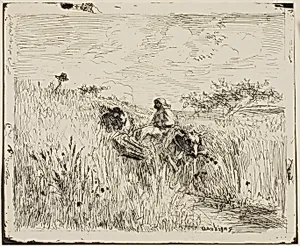
Path Through the Wheatfield
Medium
Cliché-verre on ivory photographic paper
Dimensions
Image: 14.7 × 18.5 cm (5 13/16 × 7 5/16 in.); Sheet: 16.5 × 20 cm (6 1/2 × 7 7/8 in.)
Classification
cliché-verre
Department
Prints and Drawings
Museum
Art Institute of Chicago
Accession Number
92329
Rights
Public Domain
Art Historical Context
Step into the golden glow of rural France with *Path Through the Wheatfield* (1862), a delicate landscape by Charles François Daubigny, a figure in the Barbizon school. This intimate print captures a winding path slicing through swaying wheat under an open sky, evoking the countryside Daubigny cherished near Paris. As a precursor to Impressionism Daubigny's loose, atmospheric style emphasized nature's fleeting light and texture, influencing artists like Monet and Van Gogh. What makes this work truly special is its medium: cliché-verre on ivory photographic paper. Pioneered by 19th-century French artists, this hybrid technique involved drawing directly on glass with opaque paints to create a photographic negative, then printing it via contact exposure. Daubigny experimented with it in the 1850s-60s, blending painting's expressiveness with photography's precision—a bridge between traditional art and emerging technology. At just 14.7 × 18.5 cm, this rare example from the Art Institute of Chicago's Prints and Drawings collection highlights how Barbizon painters pushed boundaries, capturing ephemeral rural beauty in an innovative, painterly photograph. Held in the museum's collection, it invites us to ponder how 1860s innovations reshaped visual storytelling, offering a window into a vanishing agrarian world.
About the Artist
Charles François Daubigny (French) · 1817 –1878
French, Paris 1817–1878 Paris