
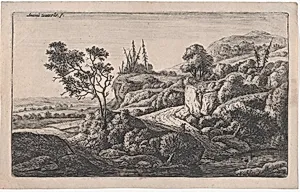
Paths Leading To a Stream
17th century
Medium
Etching; first state of two
Dimensions
sheet: 4 13/16 x 8 1/16 in. (12.2 x 20.4 cm)
Classification
Prints
Department
Drawings and Prints
Museum
Metropolitan Museum of Art, New York, NY
Credit
Gift of Kenneth Grebinar, 2005
Accession Number
2005.377.28
Rights
Public Domain
Tags
Art Historical Context
Nestled in the serene tradition of 17th-century Dutch landscape art, *Paths Leading to a Stream* is an exquisite etching by Anthonie (c. 1609–1690), a master draughtsman and printmaker of the Dutch Golden Age. Waterloo, often compared to Rembrandt for his atmospheric depth, specialized in intricate landscapes that evoke the quiet poetry of nature. This first-state impression—meaning the earliest version before any revisions—captures winding paths converging toward a gentle stream, rendered with fine lines that suggest dappled light and textured foliage. Etching, Waterloo's preferred medium, allowed for delicate, spontaneous lines etched into a copper plate with acid, producing rich tonal variations ideal for evoking the Dutch countryside's moody beauty. As a small-scale print (4 13/16 x 8 1/16 in.), it was designed for collectors, reflecting the era's booming market for affordable art that brought pastoral idylls into homes. Housed in the Metropolitan Museum of Art's Drawings and Prints department, this gifted piece from 2005 highlights Waterloo's technical precision and enduring appeal in celebrating nature's subtle paths and hidden waters.
About the Artist
Anthonie Waterloo · 1609–1690
Anthonie Waterloo (1609–1690) was a prominent Dutch Golden Age landscape artist, born on May 6 in Lille, then part of the Spanish Netherlands. Little is known of his early life beyond his mother, Magdalena Vaillant, who joined Amsterdam's Walloon Church in 1621, with Waterloo following in 1630; no records exist of formal training, and he was likely self-taught. Registered as a painter in Amsterdam...