
Patience
Classification
Department
CG-E
Museum
National Gallery of Art, Washington, D.C.
Credit
Rosenwald Collection
Accession Number
1943.3.9322
Rights
Public Domain
Art Historical Context
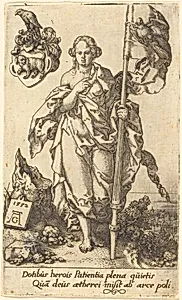
**Patience** (1552) is a captivating engraving by Heinrich Aldegrever, a masterful German artist of the Northern Renaissance known as one of the "Little Masters" for his exquisite small-scale prints. Born around 1502 in Soest, Aldegrever blended the meticulous line work of Albrecht Dürer with his own innovative flair, often crafting intricate designs on copper plates that captured allegorical, religious, and everyday themes. This print, housed in the National Gallery of Art's Rosenwald Collection (Department CG-E), exemplifies his skill in producing affordable yet profound works that reached wide audiences across Europe. Created amid the religious upheavals of the Reformation, **Patience** personifies one of the cardinal virtues, a popular motif in 16th-century art symbolizing endurance and faith in trying times. Aldegrever's engravings, prized for their fine detailing and moral depth, reflected the era's humanist interest in classical and Christian ethics, serving as both decorative objects and tools for personal reflection. Prints like this democratized high art, allowing burghers and scholars to own sophisticated imagery without commissioning originals. Though the exact medium details remain elusive, Aldegrever's technique—precise burin strokes creating texture and depth—highlights the technical brilliance of Renaissance printmaking. Visitors will appreciate how **Patience** invites contemplation, reminding us of timeless resilience in an age of change. (198 words)
About the Artist
Heinrich Aldegrever · 1502–1561
Heinrich Aldegrever, born in 1502 in Paderborn, Westphalia, to parents Herman and Katherine Trippenmeker—a family of clog-makers known by the dialect name Trippenmecker—emerged as a multifaceted artist in the German Renaissance. His early training remains undocumented, though he likely apprenticed in a Soest goldsmith's workshop after relocating there around 1525, where he joined the painters' gui...