
Patrick Lyon
c. 1800
Medium
Classification
Department
Smithsonian Collection
Museum
Smithsonian American Art Museum
Credit
National Portrait Gallery, Smithsonian Institution
Accession Number
S/NPG.97.164
Rights
Public Domain
Tags
Art Historical Context
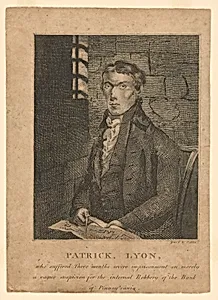
In the early 19th century, engraver James Akin captured a poignant moment of injustice in his print *Patrick Lyon* (c. 1800). Lyon, a skilled Philadelphia locksmith and blacksmith, is depicted as a sturdy mechanic amid his prison cell, surrounded by tools of his trade and possibly a map evoking his hometown. Akin's meticulous line work in this portrait print highlights Lyon's dignified resolve, transforming a personal ordeal into a symbol of resilience. Lyon's story gripped the nation: in 1798, he was falsely accused of robbing the Bank of Pennsylvania and imprisoned for nearly eight months without trial, sparking debates on liberty and due process. His eventual exoneration in 1802 made him a folk hero for the working class. Akin's print, produced around the height of the controversy, served as affordable propaganda, circulating widely to rally public support and underscore themes of wrongful imprisonment. As a print from the Smithsonian American Art Museum's collection, this work exemplifies early American graphic arts—techniques like etching and engraving allowed mass reproduction, democratizing portraiture and political commentary. It stands as a testament to how visual media amplified individual stories, influencing public opinion in a young republic.