
Pavillon ou Gynecée de Rhamsès-Meiamoun, à Médinet-habou
1849–50
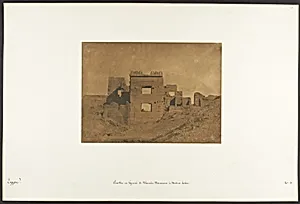
Medium
Salted paper print from paper negative
Dimensions
Image: 6 5/16 × 8 3/4 in. (16 × 22.2 cm) Mount: 12 5/16 × 18 11/16 in. (31.2 × 47.5 cm)
Classification
Photographs
Department
Photographs
Museum
Metropolitan Museum of Art, New York, NY
Credit
Gilman Collection, Gift of The Howard Gilman Foundation, 2005
Accession Number
2005.100.376.81
Rights
Public Domain
Tags
Art Historical Context
Step into the sun-drenched ruins of ancient Egypt with Maxime Du Camp's *Pavillon ou Gynec de Rhamsès-Meoun, à Médinetabou* (1849–50). Captured during Du Camp's groundbreaking expedition to Egypt alongside writer Gustave Flaubert, this salted paper print from a paper negative showcases the intricate architecture of Medinet Habu, the mortuary temple complex ofes III (Rhamsès-Meiamoun) on the west bank of the Nile near Luxor. The "pavilion or gynecée"—likely a women's quarters or reception hall—stands as a testament to New Kingdom grandeur, its towering columns and relief-carved walls frozen in time amid the desert sands. As one of the earliest photographers to document Egypt's monuments systematically, Du Camp employed the calotype process, pioneered by William Henry Fox Talbot. This technique used paper negatives to produce richly textured, atmospheric prints, allowing subtle tonal gradations that evoke the site's mystical aura. Measuring just 6 5/16 × 8 3/4 inches, the image belies its monumental subject, bridging 19th-century innovation with pharaonic legacy. Housed in The Metropolitan Museum of Art's Gilman Collection, this photograph not only preserves vanishing architectural details but also ignited Western fascination with Egyptology. Du Camp's album of over 120 such views, published in 1852, helped popularize photography as a tool for archaeology, inviting us to wander these eternal ruins from afar.
About the Artist
Maxime Du Camp · 1822–present
Maxime Du Camp (1822–1894) was a pioneering French photographer and writer whose adventurous spirit and technical innovation bridged literature and visual art during the mid-19th century. Born in Paris on February 8, 1822, to a prosperous family—his father a successful surgeon—Du Camp received a solid bourgeois education at the Collège Bourbon (now Lycée Condorcet), where he cultivated interests i...