
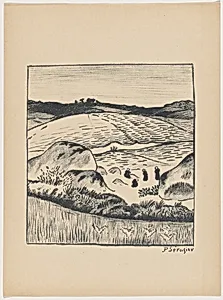
Paysage (Landscape)
1895
Medium
lithograph in black-blue on heavy japan paper
Dimensions
image: 23.2 x 21.7 cm (9 1/8 x 8 9/16 in.) sheet: 38 x 28.2 cm (14 15/16 x 11 1/8 in.)
Classification
Department
CG-E
Museum
National Gallery of Art, Washington, D.C.
Credit
Virginia and Ira Jackson Collection, gift in memory of Virginia H. Jackson
Accession Number
1996.151.73
Rights
Public Domain
Art Historical Context
**Paysage (Landscape by Paul Sérusier, created in 1895, the essence of the French artist's Post-Impressionist vision through a striking lithograph in black-blue ink on heavy japan paper. Sérusier (1864–1927), a founding member of the avant-garde group Les Nabis, was renowned for his bold experiments in color and form, influenced by Paul Gauguin and thehetist movement. This intimate print, measuring 23.2 x 21.7 cm, invites viewers into a poetic evocation of nature, likely inspired by the Brittany landscapes that shaped his early career. Lithography, a technique Sérusier embraced for its fluid, painterly qualities, allowed him to blend drawing and printing seamlessly on the luxurious japan paper, which enhanced the ink's depth and texture. The monochromatic black-blue palette creates a moody, atmospheric effect, reflecting the Nabis' emphasis on symbolism and decoration over literal representation—a departure from academic realism in late 19th-century France. Housed in the National Gallery of Art's Prints department as part of the Virginia and Ira Jackson Collection, this work exemplifies the era's revival of original prints as accessible art. It offers a window into Sérusier's innovative spirit, bridging painting and printmaking for a new generation of collectors and admirers.
About the Artist
Paul Sérusier · 1864–1927
The painter first studied at the Lycée Condorcet in Paris, focusing on philosophy, then painting at the Académie Julian from 1885-1890. His painting of a Breton Weaver won an honorable mention at the Salon of 1888. He was the principal figure in the formation of the group known as the Nabis, in the same year. In 1896 he collaborated on masks and sets for the first performance of Alfred Jarry’s Ubu...