
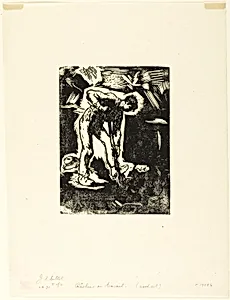
Peasant Digging
Medium
Woodcut on greenish-gray laid paper
Dimensions
Image: 14.2 × 10.6 cm (5 5/8 × 4 3/16 in.); Sheet: 28.2 × 21.2 cm (11 1/8 × 8 3/8 in.)
Classification
woodcut
Department
Prints and Drawings
Museum
Art Institute of Chicago
Accession Number
76459
Rights
Public Domain
Art Historical Context
Jean-François Millet's *Peasant Digging*1863) captures the quiet dignity of rural labor, a hallmark of the artist's realist style. As a leading figure in the Barbizon School Millet drew inspiration from the French countryside near Barbizon, where he lived and worked. This woodcut portrays a solitary peasant at work, emphasizing the physical toil and endurance of everyday people during an era of social upheaval, including the industrialization of mid-19th-century France. Millet's empathetic gaze elevated peasants from mere subjects to symbols of humanity's noble struggle, influencing later artists like Vincent van Gogh. Printed on greenish-gray laid paper, the woodcut measures a modest 14.2 × 10.6 cm, allowing for intimate viewing. Woodcuts, a relief printing technique where the artist carves away negative space from a woodblock, were Millet's chosen medium for broader accessibility—affordable reproductions that brought his monumental paintings to a wider audience. The subtle tonal variations and textured lines evoke the earthy grit of the soil, showcasing Millet's mastery in translating painterly realism to print. Housed in the Art Institute of Chicago's Prints and Drawings Department, this work exemplifies 19th-century printmaking's role in democratizing art, bridging fine art with popular culture and underscoring Millet's enduring legacy in celebrating the unsung lives of the working class.