
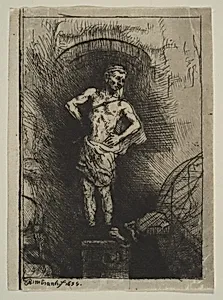
The Image Seen by Nebuchadnezzar
Medium
Etching, burin, and drypoint; third of five states
Dimensions
Sheet (Trimmed): 4 5/16 × 3 1/16 in. (10.9 × 7.8 cm)
Classification
Prints
Department
Drawings and Prints
Museum
Metropolitan Museum of Art, New York, NY
Credit
Harris Brisbane Dick Fund, 1926
Accession Number
26.72.155
Rights
Public Domain
Tags
Art Historical Context
In the heart of Rembrandt van Rijn's masterful printmaking lies *The Image Seen by Nebuchadnezzar* (1655), an etching that captures a pivotal biblical vision from the Book of Daniel. King Nebuchadnezzar of Babylon dreams of a colossal statue—head of gold, chest of silver, thighs of bronze—symbolizing successive empires foretold by the prophet Daniel. Rembrandt, at the peak of his Baroque career, renders this prophetic image with dramatic intensity, evoking the dream's otherworldly grandeur and imperial might. The work reflects 17th-century fascination with scripture, blending religious narrative with Rembrandt's profound psychological insight. Crafted in etching, burin, and drypoint on a modest 4 5/16 × 3 1/16 in. sheet, this is the third of five states, showcasing Rembrandt's innovative process of refining plates through multiple proofs. The burin's precise lines and drypoint's velvety burr create rich textures and shadowy depths, hallmarks of his printmaking genius. These techniques allowed for subtle tonal variations, making each impression uniquely alive—prized by collectors then and now. Housed in the Metropolitan Museum of Art's Drawings and Prints department (Harris Brisbane Dick Fund, 1926), this intimate yet monumental print invites visitors to ponder ancient prophecies through a master's eyes, bridging Dutch Golden Age artistry with timeless human curiosity.
About the Artist
Rembrandt (Rembrandt van Rijn) · 1606–1669
Rembrandt Harmenszoon van Rijn (1606–1669) stands as one of the greatest visual artists in the history of Western art and the most important Dutch painter of the 17th century. Born in Leiden to a prosperous miller's family, Rembrandt transformed painting through his revolutionary use of light and shadow, his psychological depth in portraiture, and his elevation of etching to a fine art. His approx...