
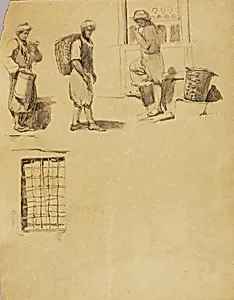
Peasant Figures
Medium
Drawing
Classification
Drawing
Department
Smithsonian Collection
Museum
Smithsonian American Art Museum
Credit
Smithsonian American Art Museum, Bequest of Martha F. Butler
Accession Number
1991.56.86
Rights
Public Domain
Tags
Art Historical Context
Miner Kilbourne Kellogg (1814–1889) was a prominent 19th-century American artist for his neoclassical portraits, landscapes, and genre scenes inspired by extensive travels in Europe and the Middle East. Active during the Romantic era, Kellogg often captured the dignity of ordinary people, blending meticulous draftsmanship with a keen eye for human emotion and daily life. "Peasant Figures," an undated drawing from the Smithsonian Art Museum's collection, exemplifies his skill in rendering humble subjects with sensitivity. This work, bequeathed by Martha F. Butler, depicts male peasant figures in a modest setting, incorporating elements like a window and container that suggest domestic or rural routines—hallmarks of 19th-century genre art. As a drawing, it highlights Kellogg's mastery of line and shading, likely used as a study for larger paintings or as a standalone piece valued for its immediacy and spontaneity. Drawings from this period were prized for their intimacy, offering glimpses into an artist's process amid growing American interest in European realism. Housed in the Smithsonian's vast holdings, "Peasant Figures" invites visitors to appreciate how Kellogg bridged American and international influences, celebrating the quiet narratives of working folk in a rapidly industrializing world.