
Peasant with Sack
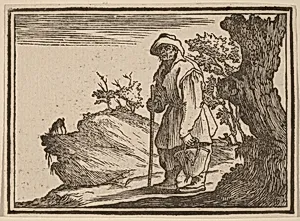
Medium
woodcut on laid paper
Dimensions
sheet (trimmed to block): 6.3 × 8.5 cm (2 1/2 × 3 3/8 in.)
Classification
Department
CG-E
Museum
National Gallery of Art, Washington, D.C.
Credit
R.L. Baumfeld Collection
Accession Number
1969.15.225
Rights
Public Domain
Art Historical Context
"Peasant with Sack" a delicate woodcut on laid paper created in 1621 by Edouard Eck after the renowned French printmaker Jacques Callot. Measuring just 6.3 × 8.5 cm, this trimmed sheet captures a humble figure burdened with a sack, evoking the gritty realities of early 17th-century rural life. Part of the National Gallery of Art's R. Baumfeld Collection (-E department), it exemplifies the intimate scale of period prints designed for close viewing. Jacques Callot, a master intricate line work, was celebrated for his series depicting vagabonds, beggars, and peasants—such as his famous *Gueux* (Beggars) suite from around this time. These works offer a vivid snapshot of Europe's social underbelly during the lead-up to the Thirty Years' War, blending empathy with sharp observation. Eckman's woodcut reproduction translates Callot's original etching technique into relief printing, a labor-intensive process where the image is carved into wood blocks for multiple impressions on handmade laid paper, making art accessible beyond elite circles. This print highlights woodcuts' role in democratizing imagery, preserving Callot's masterful detail in a portable format. Visitors will appreciate how such small-scale works packed profound cultural commentary into everyday scenes, bridging fine art and social history.
About the Artist
Edouard Eckman after Jacques Callot
Edouard Eckman, a Flemish printmaker born around 1600, remains a somewhat enigmatic figure in art history, with his early life not well documented. Little is known about his training or formal education, though his oeuvre suggests familiarity with the vibrant printmaking traditions of the early Baroque period in Northern Europe. Active primarily in the second decade of the seventeenth century, Eck...